
Find South St. Paul Residents
A useful South St. Paul residents directory search begins with the detail that can be checked, not with a broad name match. An address points to the county parcel map. A current court question belongs in the court index. An older family question belongs in a dated directory, census, newspaper, or museum collection. These records overlap, but they do not mean the same thing. A deed party may be a lender or attorney. A directory listing fixes a person at an address for that edition only. A city archive hit may be a council document rather than proof of residence.
Start with the record that fits the question, then preserve its date and source. Dakota County has no single public name list for all South St. Paul residents. The strongest trail often combines an address-based parcel search, a dated historical source, and a custodian check. When the goal is a specific person rather than a household or street, the South St. Paul resident lookup route keeps the evidence separate.
- Enter the exact street address or parcel ID in Dakota County Property Information and save the parcel ID, municipality, legal description, and access date.
- Use the name, address, or date range in the record system that matches the event, such as the city archive, MCRO, or a historical directory.
- Check the recorder index when the parcel trail needs a dated deed or other recorded instrument. RecordEASE requires an account for the full search.
- For an earlier household, compare the SPPL street or name section with DCHS census, obituary, newspaper, or plat material.
- When an online result is incomplete, ask the named custodian for a narrow record set, date range, and inspection or copy option.
South St. Paul Resident Records Offices
South St. Paul municipal records begin at City Hall, while land, elections, and many court functions sit with Dakota County. That split matters. The City Clerk holds city papers, minutes, ordinances, licenses, and public-data requests. Dakota County Property Taxation & Records maintains recorded land documents, and the county map supplies the parcel context that makes an address search precise. The election office can identify a precinct from an address, but its public tool is not a household-name search.
Dakota County Property Taxation & Records
1590 Highway 55
Hastings, MN 55033
651-438-4597
Dakota County Property Information
Western Service Center
Apple Valley, MN
952-891-7081
Property Taxation & Records accepts document and research requests by mail, appointment, phone, and email. The Western Service Center has two public Property Information terminals. The City Clerk remains the best first contact for municipal papers and city requests. Those alternatives matter when a web search does not expose an older item or a certified copy.
South St. Paul Parcel Records
Dakota County Property Information Search is the cleanest starting point for a South St. Paul address. Its documented public modes are street address and parcel ID, not owner name. The map can lead to a printable property card and displays parcel-related information, tax material, valuation notices, sketches, and map context. Save the situs address, parcel ID, municipality, and legal description before moving to a deed or directory. A mailing address can differ from the property address.
| Property search control | Use in a South St. Paul search |
|---|---|
| Street address | Begin with the house number and street, including the correct directional and street type. |
| Parcel ID | Use the stable county identifier once an address result is found. |
| Layers and basemap | Check parcels, roads, aerials, contours, parks, and floodplain context. |
| Print property card | Keep the date and parcel reference with any downloaded record. |
The Online Property Maps page also describes the county GIS and about 150 available layers. It is an orientation tool, not a title opinion or a current-resident roster. For a full address-by-address chain, use the South St. Paul street directory after the parcel is identified.
Check the county’s Map Catalog when a property-card search is unavailable or a map download is needed.
South St. Paul Court Lookup
A court record is a separate South St. Paul residents directory source. Dakota County District Court uses Minnesota Court Records Online, or MCRO, for its statewide case, document, hearing, and judgment searches. The Case Search lets a user select a name type, enter last, first, and middle names, use a date of birth or filing-date range, choose a category or court location, and try Sounds Like or a wildcard. Select Dakota County when a location filter is needed.
MCRO is free and does not require registration, but it is unofficial and cannot provide certified copies. Pending criminal and traffic matters do not return by defendant name before conviction. Protected, expunged, destroyed, older, and local-only material can also be absent. The courthouse, court administration, and a public-access terminal are the fallback for a certified copy or an unavailable file. A missing online result is not a conclusion about a person.
Use the official MCRO Case Search for the documented field set.
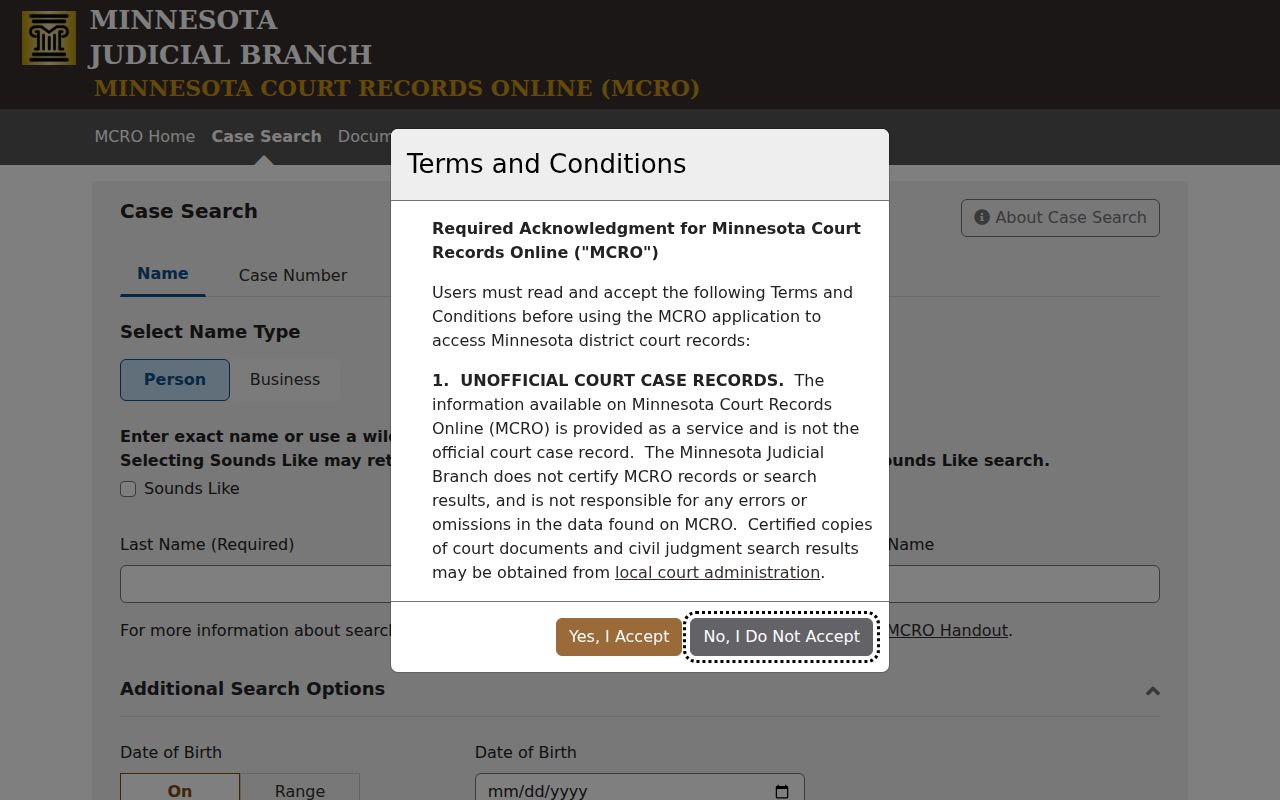
Separate exact-name, wildcard, punctuation, suffix, and Sounds Like searches help avoid treating one spelling as a complete search.
South St. Paul Voter Data
Minnesota has two very different election tools. Dakota County’s Find My Polling Place accepts a street address and returns precinct and polling-place information. It is useful geographic confirmation, but it does not list the people registered at that address. The state voter list is requested through the Secretary of State under Minn. Stat. §201.091, with restricted fields removed and controlled formats, fees, certification, and delivery options.
For a lawful personal records request, state the geography and product needed instead of requesting a broad name file. The research notes listed geographic products generally at $30 and statewide output at $46, with a five-business-day fulfillment description on the form. Recheck the current form before submitting. A protected participant can have confidential voter treatment, so no response or a substitute address should be respected rather than worked around.
See the county polling-place lookup for its address-first design.
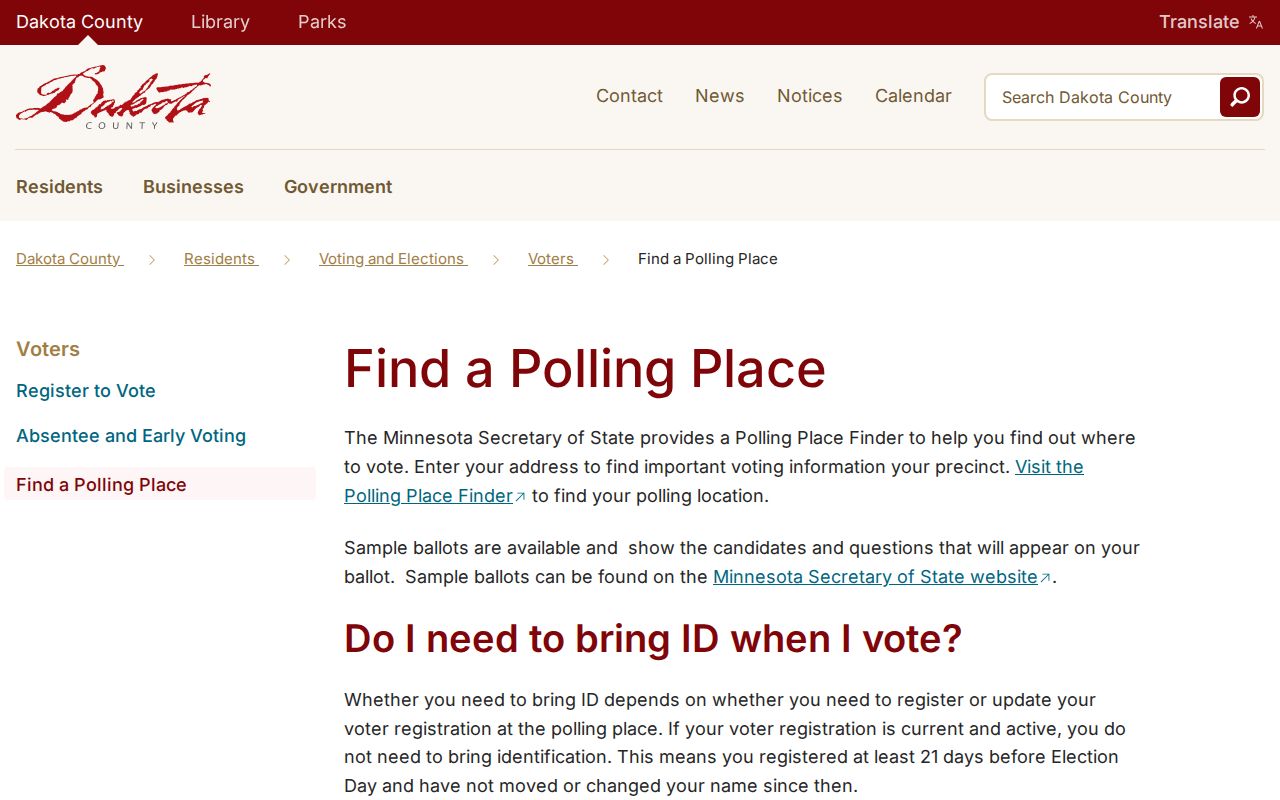
The result connects an address to precinct geography, not a list of people.
Current South St. Paul Resident Directories
Several current systems resemble a residents directory, but each has a narrow purpose. A parcel result connects land and address. RecordEASE records parties to instruments. The city staff directory lists employees, not households. A court or license index answers a case or credential question. Comparing sources by role keeps a South St. Paul result from being treated as more than the custodian says it is.
| South St. Paul source | Record relationship | Custodian | Access route |
|---|---|---|---|
| Property Information | Parcel, situs address, tax and map context | Dakota County | Free address or parcel search |
| RecordEASE | Recorded-document parties and references | Property Taxation & Records | Account, office, copy request |
| City Archive | Names or addresses in municipal documents | South St. Paul | Keyword, type, time, date range |
| Voter file request | Public voter-list data permitted by law | Secretary of State | Request form and delivery controls |
| DCHS Search Records | Church, cemetery, census and local entries | Dakota County Historical Society | Partial online search and research help |
A commercial directory can be convenient, but it may combine old, incomplete, or mismatched data without showing the custodian or date. Official indexes make it easier to check the record type, access limit, and update point. That matters for genealogy, estate questions, reconnection, and civic research.
| Official record route | Commercial directory category |
|---|---|
| Names the office, source date, record type, and request path. | May combine sources with unclear timing or relationship. |
| Allows a copy, inspection, or custodian follow-up when offered. | Cannot replace a custodian’s confirmation or certified copy. |
South St. Paul City Archive
The South St. Paul City Archive provides keyword, archive-type, time-period, and date-range controls, plus browse options. It is a good municipal route when a name, organization, street, ordinance, license, or meeting topic is known. Keep the archive category and date with a hit. A name can appear as a speaker, applicant, official, vendor, or subject in a council item, so the document itself determines what the result means.
The City Clerk at South St. Paul City Hall has custody of city papers, agendas, minutes, ordinances, resolutions, licenses, elections, and public-data requests. The clerk’s published regular hours are Monday through Friday, 8:00 a.m. to 4:30 p.m., with a seasonal summer schedule also posted. Contact the clerk before relying on a historic online archive gap, because office, phone, mail, and request channels remain available.
Open the City Clerk office page before making a narrow municipal request.
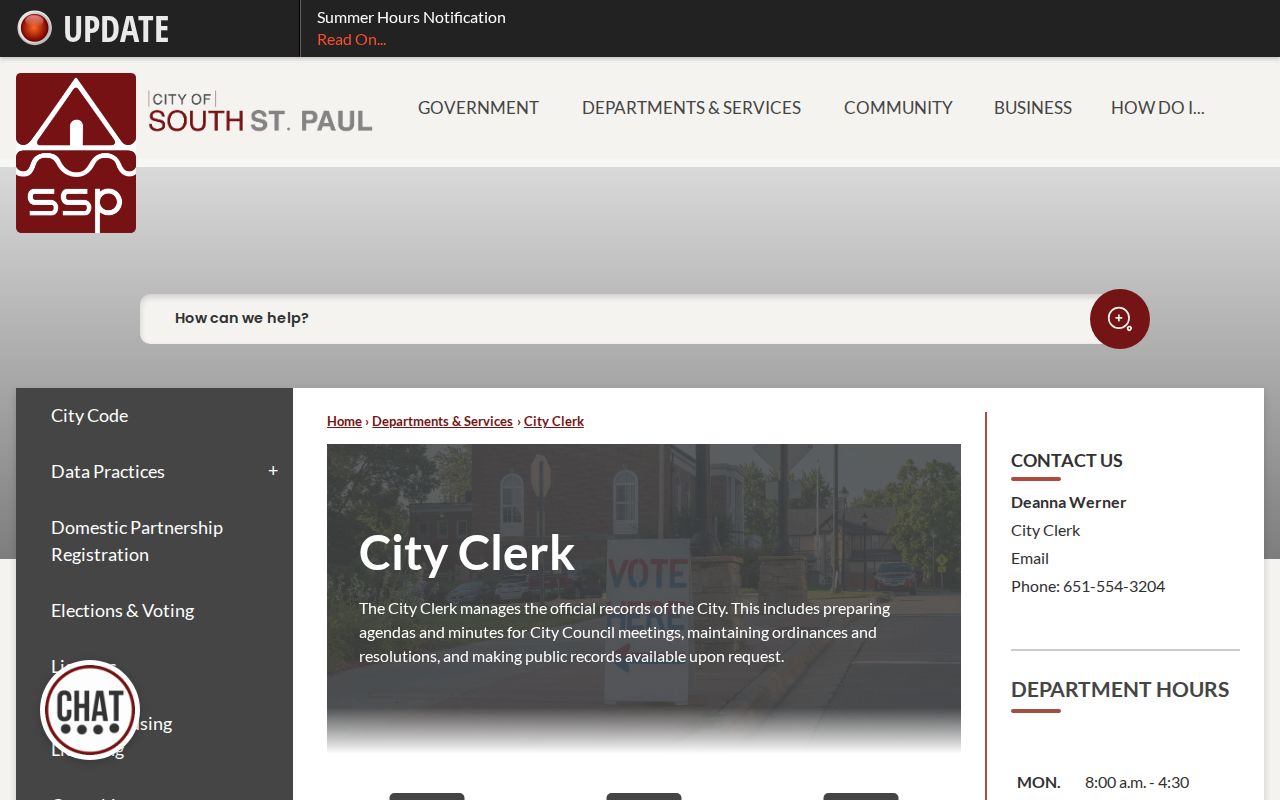
Municipal records can identify a document trail, but the city archive is not a general roster of residents.
South St. Paul Vital Trails
Vital records use a separate state and county system. The Minnesota Department of Health maintains statewide birth records from 1900 and death records from 1908. Dakota County can issue Minnesota death certificates and county marriage copies, while marriage copies come from the county that issued the license and divorce decrees belong with the district court. The MDH death verification search requires an exact first name, last name, and date of birth or Social Security number, then returns limited verification information rather than a certificate.
Minn. Stat. §§144.225 through 144.227 govern public and confidential vital data, certified-copy eligibility, and administration. Noncertified death information is public; certified copies require the relationship or legal basis, identification, and attestation described by the custodian. MDH offers mail and fax routes but does not accept emailed applications. Dakota County’s certified-death route lists in-person and mail options. Preserve an index result as a lead, then use the eligible route when a record copy is needed.
Review the official Minnesota death search before relying on exact-match verification.
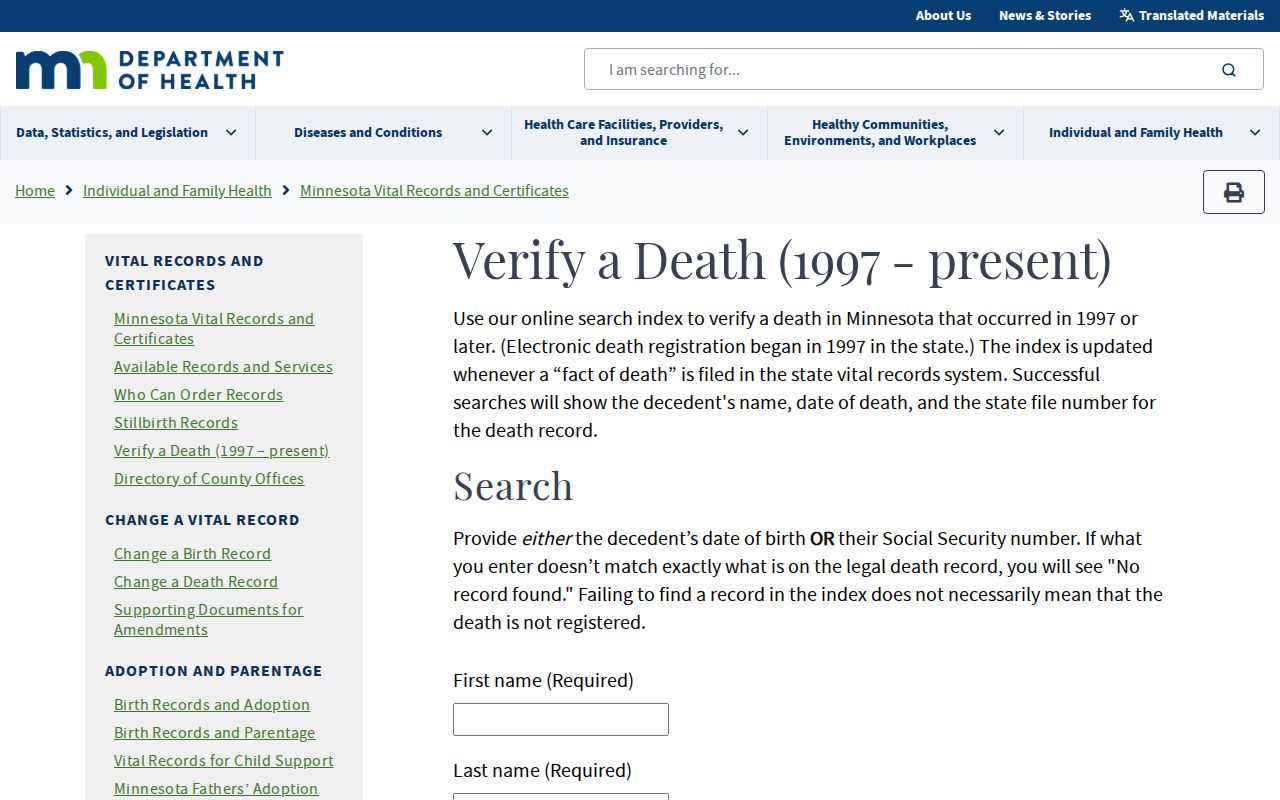
The visible fields show why a partial name alone is not enough for this verification tool.
South St. Paul Resident Privacy
Public availability is not permission to turn a record into an unrestricted profile. The Minnesota Government Data Practices Act, Minn. Stat. ch. 13, presumes government data are public unless another law or classification makes them not public. Inspection is free, while copies can carry an actual-cost charge. A useful request identifies the record type, date range, name or address, requested format, and whether inspection or copies are wanted. Narrow requests reduce cost and privacy review.
- Roll
- A list created for a particular public purpose, not a universal resident list.
- Index
- A finding tool that points to a record; it is not always the original document.
- Parcel
- A county-defined piece of land identified by a parcel ID and legal description.
- Criss-cross directory
- A historical directory arranged by street or address rather than by surname.
Safe at Home is Minnesota’s address-confidentiality program. A participant can use a substitute address and receive confidential voter treatment. Sealing, protected-address, and court rules can create additional gaps. Do not interpret an absent address as a problem to solve.
Historical South St. Paul Resident Directories
South St. Paul’s historical resident trail is especially strong when the date is known. Saint Paul Public Library makes digital city directories available for 1856 through 1922 and holds later material in microfiche, microfilm, and print. The library describes a separate South St. Paul street index in the 1929 edition, while South St. Paul names appear in the St. Paul white pages. The 1956 to 1991 suburban run is another distinct series. Directory formats changed, so preserve the edition, page, section, spelling, and whether an entry came from a name or street section.
The South St. Paul Directory Book details the library runs, entry conventions, and household tracing method. Here, the key point is scope: a listing is evidence that a named person or business appeared in that edition. It does not prove ownership, a complete household, continuous residence, or an unchanged street number. A missing result may reflect the wrong section, a missing volume, a boundary, or an adult/child listing convention.
South St. Paul Lawshe Records
The Lawshe Memorial Museum, operated by the Dakota County Historical Society, is the local research stop that a broad web search cannot replace. It is at 130 3rd Avenue North in South St. Paul and holds local histories, newspapers on microfilm back to the 1850s, federal and state census material from 1849 to 1940, cemetery and obituary files, naturalization and Catholic church records, plat maps, telephone books, city directories, oral histories, and photos. Appointments are encouraged but not required, and staff ask researchers to call first at 651-552-7548.
DCHS also offers a partial online Search Records system with a keyword field and record-type selector, covering more than half a million church, cemetery, census, WWI biography, and other local entries. The online set is not complete. A no-result should lead to a museum inquiry, research request, or a check of SPPL and Minnesota Historical Society collections, not a claim that a person was absent.
South St. Paul Recordkeeping Eras
South St. Paul formed in 1887, and its record trail changes with its industrial growth, the stockyards era, later closure, and redevelopment. Early streets and property questions may need directories, plats, newspapers, recorder books, or city archives. From 1929 through 1940, the library identifies shifts such as a homeowner symbol, wives’ names, all-adult listings, and a telephone indicator. The 1950 to 1970 period adds suburban directory and phone-number context. Current GIS, ePermits, MCRO, and the municipal archive belong to the later digital era.
The county’s Mapping Prejudice layer adds one historical parcel context. Dakota County says its map is complete for discriminatory covenants. It is a land-history research layer, not a current resident label. Use it with the recorded document, parcel date, and historical source, and do not make inferences about a current household from a covenant record.
South St. Paul Custody Searches
Custody and criminal-history resources should not be blended into a general resident result. The Dakota County Jail Inmate Search is limited to people currently in custody, and the sheriff warns that results may not be current, accurate, or complete. State Department of Corrections and BCA paths have separate jurisdictions, status rules, and identity limits. Court records have another set of access limits.
Open the official Dakota County Jail search only when its current-custody scope matches the question.
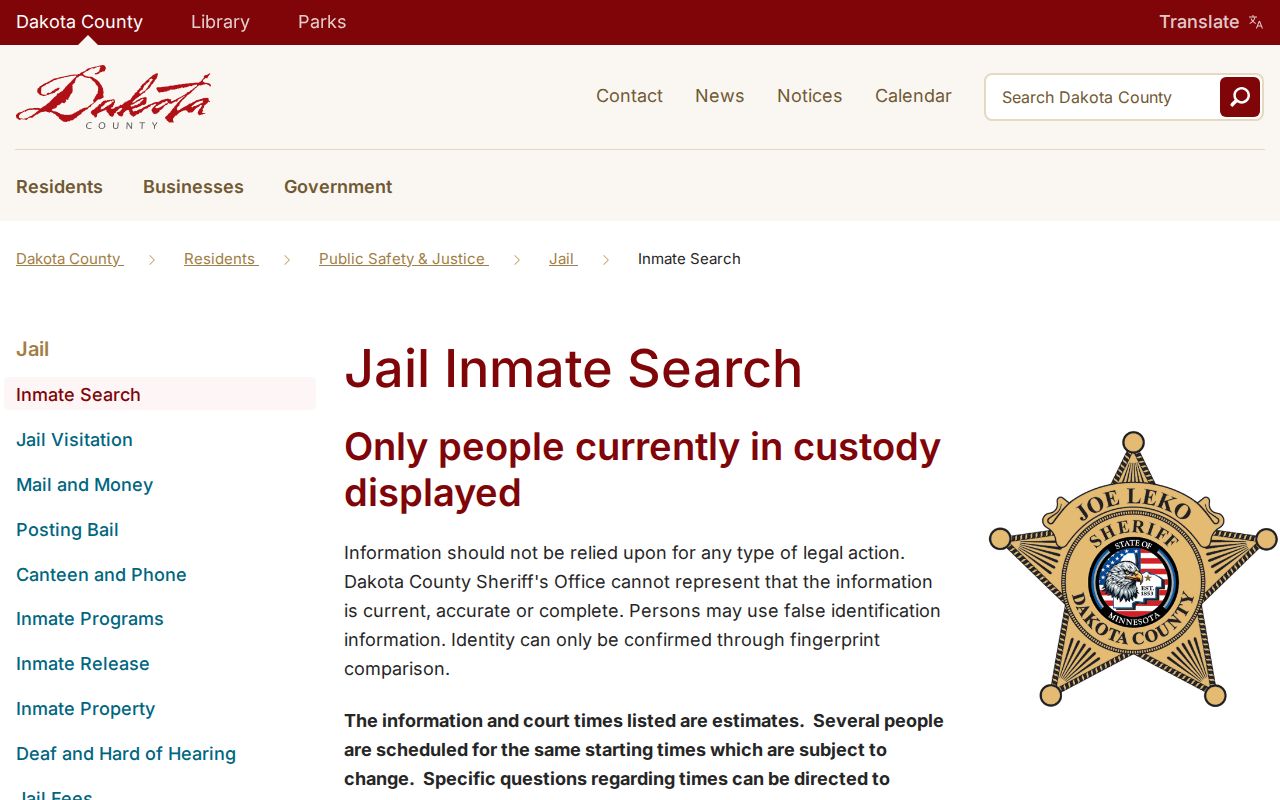
The screen’s custody-focused fields reinforce that it cannot establish a person’s ordinary residence or complete history.
For state correctional jurisdiction, use the Minnesota DOC individual and registrant search.
DOC information has its own disclosure and status limits, so retain the custodian and search date with any result.
South St. Paul License Records
A state license or business filing can confirm a professional or entity record, not a household. Minnesota’s umbrella License Minnesota search links to participating boards and agencies. DLI offers a guest search by license or registration number and additional criteria for its categories. Other boards use their own fields, status rules, and refresh cycles. Record the agency, license number, status date, and category rather than treating a city or ZIP field as a verified residence.
View the captured state license search as a starting interface, then use the issuing agency’s result as controlling.
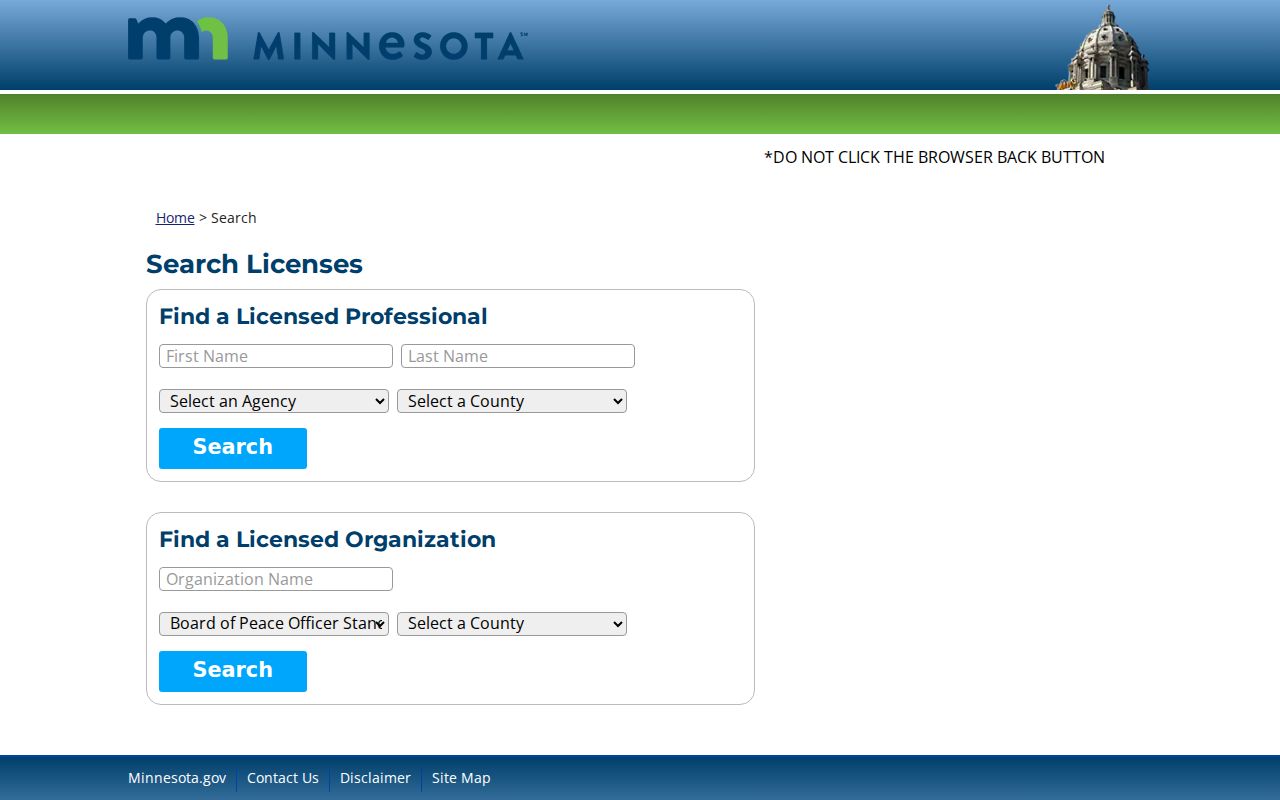
The state interface is a record-by-agency gateway, not a comprehensive South St. Paul resident roll.
South St. Paul Property Watch
Dakota County Property Watch is a forward-looking recording alert, not a way to reconstruct every former household. A subscriber provides a name, entity, or property, legal description, and email. Future matching recordings generate an alert with the party name, recorded date, document number, and document type. Common names can produce many alerts. Use the alert to monitor a lawful property interest, then obtain the underlying document through the county if it matters.
The Property Watch page was updated in July 2026 in the research record. Recheck its current instructions before enrollment. For older deeds, missing images, and pre-index material, use RecordEASE, the recorder’s research route, the Lawshe Museum, DCHS, SPPL, and Minnesota Historical Society collections as appropriate.
Note: A name in a recording notice identifies a document relationship, not necessarily a current South St. Paul resident.